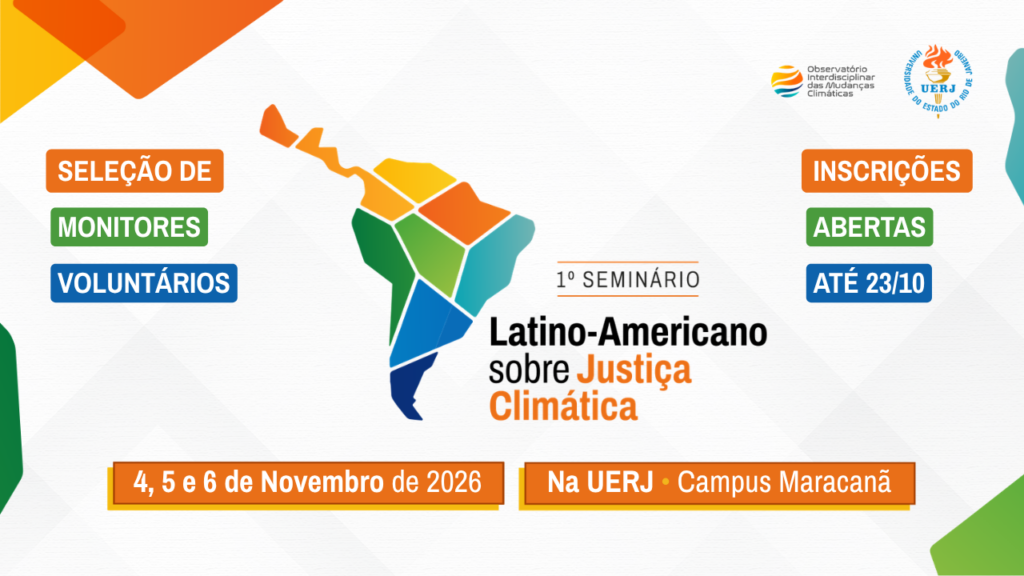
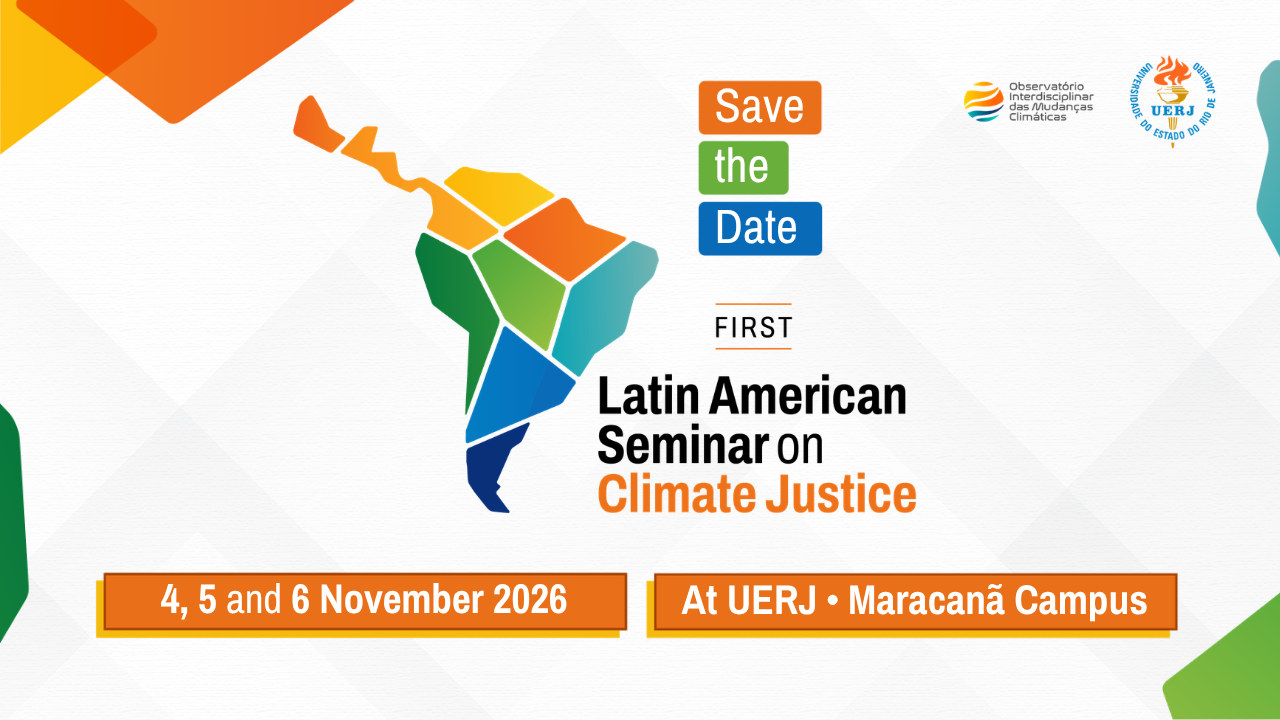
The Interdisciplinary Observatory on Climate Change is proud to announce the dates of the first Latin American Seminar on Climate Justice (SLAJC), to be held by our team from 4 to 6 November 2026 at the Maracanã campus of the Rio de Janeiro State University (UERJ). One year after COP 30 in Belém, the 1st SLAJC aims to create interdisciplinary spaces for dialogue, and to generate and disseminate knowledge and practices in the field of climate justice through contributions from researchers, students, public officials and representatives of civil society from Latin America and the Caribbean.
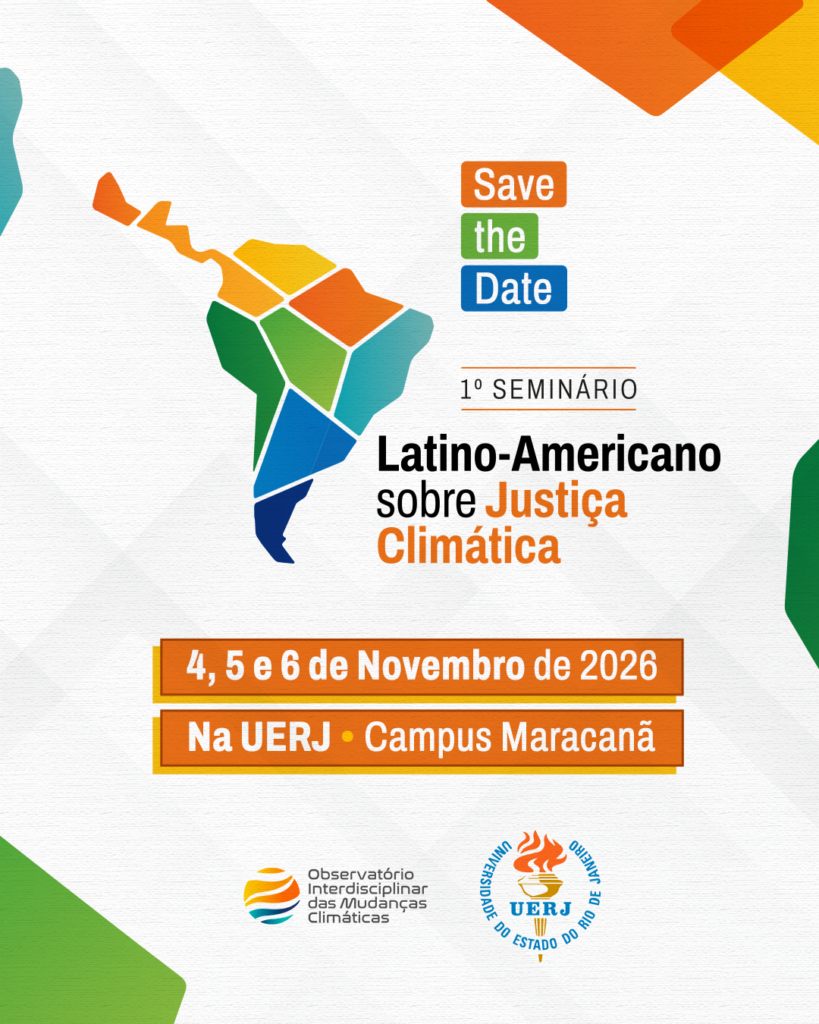
Organised with the institutional support of various graduate programs at UERJ, such as those in Environmental Studies (PPGMA/UERJ), Political Science (PPGCP/IESP-UERJ) and International Relations (PPGRI/UERJ), the event plans to offer nine thematic panels and nine training workshops over three days. Topics for discussion at the panels will include just transition and environmental racism, public policies on climate adaptation, oceans and mangroves, information integrity and climate obstruction, multilateralism and climate negotiations, and science and art in tackling the climate crisis, amongst others. The workshops, meanwhile, will address methods and practices related to the climate agenda, including a COP simulation and training sessions on the relationship between subjective perception and knowledge in understanding climate vulnerabilities, on data collection in peripheral territories and focus groups, on research methodologies concerning climate obstruction, and on knowledges for building climate justice. Starting in mid-September, the OIMC will open online registration for those interested in each of the activities.
The SLAJC already has a number of confirmed participants, including experts, leaders and activists from various areas of the climate agenda, such as:
- Maritza Paredes (PUC-Peru)
- Ricardo Gutiérrez (UNSAM – Argentina)
- Lucas Christel (UNSAM – Argentina)
- Luis Rivera Vélez (CECMA – Mexico)
- Cecilia Osorio Gonnet (Universidad del Chile)
- Natália Lever (Ashoka – USA)
- Detlef Nolte (GIGA and University of Hamburg – Germany)
- Anna Funfgeld (GIGA and University of Hamburg – Germany)
- Fabiana Barbi (Unicamp)
- Diego Kern Lopes (UERJ)
- Cristiana Losekann (UFES)
- Sinara Sandri (University of Coimbra)
- Michele Massuchin (UFPR)
- Leticia Capone (UFRJ)
- Mary Jane Fonseca (Resex Curipuru)
- Carlinhos da AMEX (CONFREM)
- Celso Sánchez (UNIRIO)
- Sidney Guerra (UFRJ)
- Ana Karina Brenner (UERJ).
The more than 40 members of the Observatory will act as moderators for the panel discussions and workshops. The concept of climate justice refers to the intersection between climate action and social justice, based on the recognition that the main contributors to the climate crisis are those who can most easily adapt to its harmful effects, whilst the groups most vulnerable to the consequences of the climate emergency and their territories – with fewer resources (financial, technological) and lower relative adaptive capacities – are those that contribute least to greenhouse gas (GHG) emissions, both historically and at present. These inequalities and asymmetries are present in national and local contexts, but equally so in international relations and international political economy. Reflecting on climate justice also brings to the forefront the debate on the responsibility of the present generation towards future generations and non-human forms of life. Learn more by consulting the OIMC Glossary.
To round off this rich and diverse array of themes, knowledge and practices centred on the climate justice agenda, the SLAJC will welcome the contribution of the Co-ordination of Arts and Creative Workshops (COART/UERJ) in developing artistic activities throughout the three-day event. At the end of the event’s extensive programme, a closing reception will be offered, featuring the presentation of books, studies and policies aimed at promoting a transition that integrates the different dimensions of justice (ecological, social, energy and development models), accompanied by a performance from the band Os Capitães da Areia, as part of UERJ’s Esquenta Cultural programme.