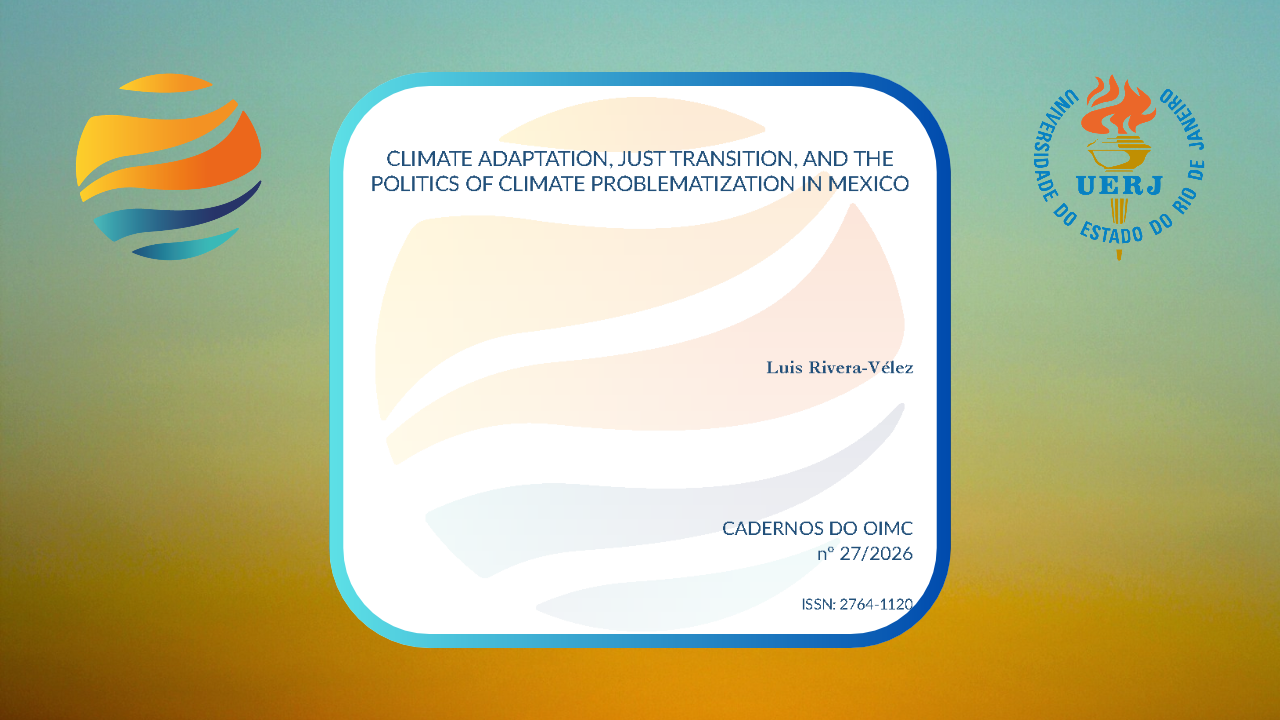
Continuing the series of five policy papers developed as part of the project South-South Relations and COP30: Adaptation and Just Transition, with support from the Instituto Clima e Sociedade (iCS), the Interdisciplinary Observatory on Climate Change is publishing another volume of Cadernos do OIMC. In its 27th edition, the Cadernos presents the article ‘Climate Adaptation, Just Transition, and the Politics of Climate Problematisation in Mexico’, authored by political scientist Luis Rivera-Vélez (CEMCA)
Read extracts from the article’s abstract:
Mexico has developed one of the most sophisticated climate governance frameworks in Latin America, combining climate legislation, planning instruments, adaptation strategies, emissions targets, and international commitments. Yet this institutional expansion coexists with continued hydrocarbon dependence and expansion, environmentally damaging infrastructure projects, and uneven implementation. This policy brief argues that these contradictions reflect different processes of climate problematization: climate issues may become institutionally recognized without generating sufficient political debate or acquiring the political priority necessary to reshape development trajectories consistent with effective climate mitigation. (…) The brief concludes that Mexico’s main challenge is not institutional absence, but weak and uneven political anchoring of climate action in socio-territorial realities.
PhD in Political Science from Sciences Po Paris, Luis Rivera-Vélez is currently a postdoctoral researcher at the Centre for Mexican and Central American Studies (CEMCA) in Mexico City. His research focuses on the analysis of public policy, institutional change, bureaucracies and social movements, with a particular emphasis on drug policy and climate policy in Latin America. His research examines the processes of public policy formulation and implementation, as well as forms of resistance, contestation and transformation of public action.