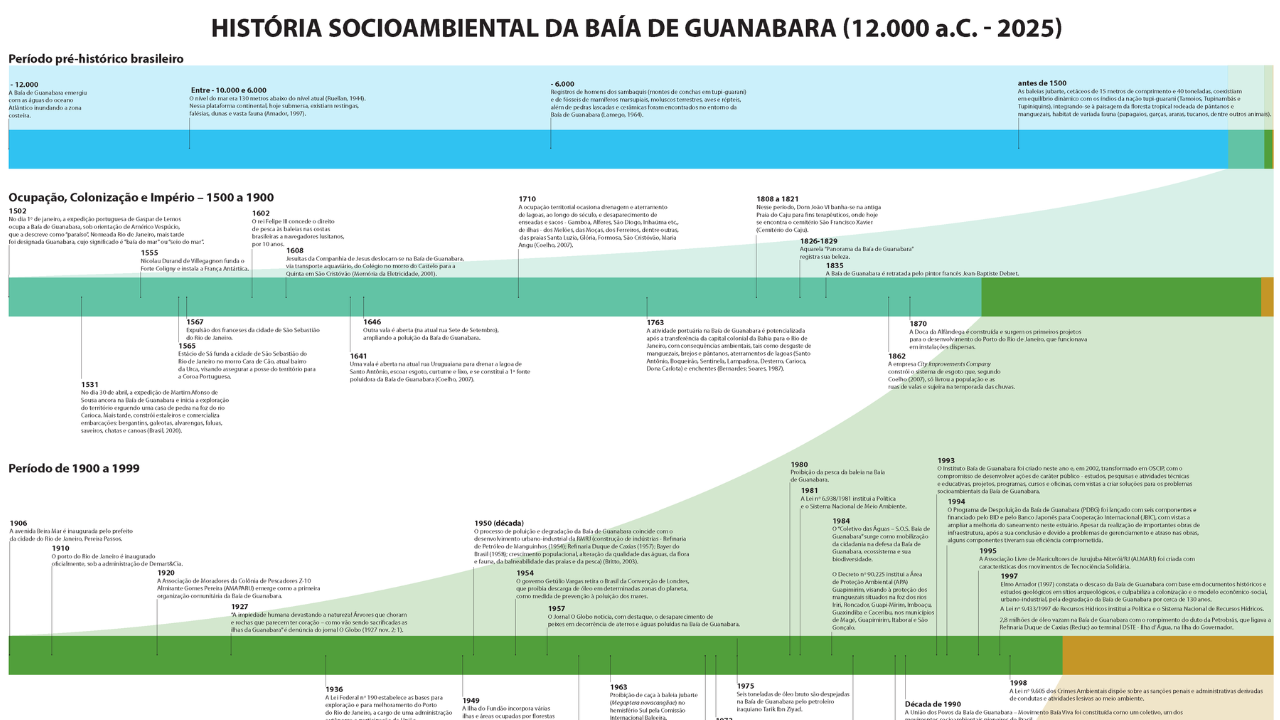
Prof. Elza Neffa (PPGMA-UERJ), a researcher on the Strategic Committee of the Interdisciplinary Observatory on Climate Change, has produced, based on data collected by the Socio-environmental Module of the Long-term Ecological Research Programme (PELD-Guanabara – UERJ/UFRJ/CNPq), the timeline Socio-environmental History of Guanabara Bay – 12,000 BC – 2025. With a visual narrative developed by the LABMUNDO Cartography Studio, under the coordination of our associate researcher Prof. Rubens de S. Duarte (IMM-ECEME), the image presents a chronological arrangement of emblematic historical events and relates them to the process of ecosystem transformation.
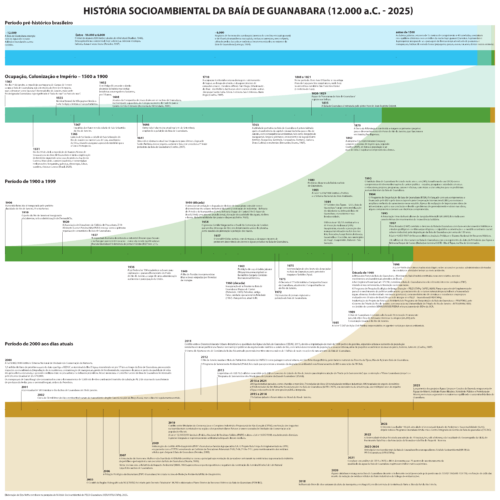
This visual narrative, illustrated by the transition from crystal-clear water to water darkened by pollution, using shades of blue (light and dark), green and brown, aims to highlight the sequence, the connections and the acceleration of human actions, and the impacts that have led to the current state of degradation, as well as urging individuals and public and private institutions to take responsibility for transforming it into a symbolic portrait of the beauty of the city of Rio de Janeiro.
Implemented by the National Council for Scientific and Technological Development (CNPq), the Long-Term Ecological Research Programme (PELD) coordinates a network of reference sites for scientific research in the field of ecosystem ecology. Through PELD, CNPq promotes the generation of high-quality knowledge about our ecosystems and the biodiversity they harbour. The information collected by PELD includes long-term time series of data on ecosystems and their associated biota.
In our Map Library, you can view over 4,000 images like this one, produced in partnership with the Cartography Studio, ranging from maps to charts, timelines and tables, which illustrate information relating to climate change, public policy and international relations.