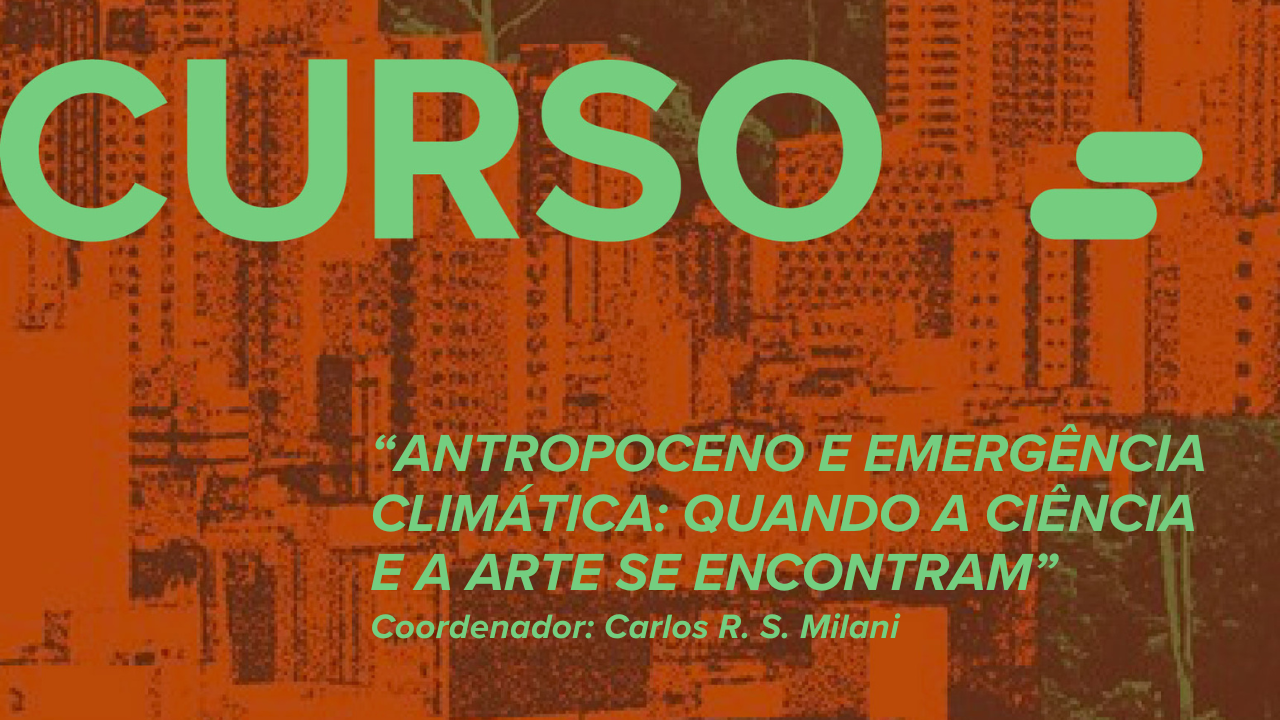
From 16 to 26 March 2026, the Interdisciplinary Observatory on Climate Change is joining forces with the Getúlio Vargas Foundation (FGV Arte) to offer the mini-course The Anthropocene and the Climate Emergency: where art and science meet, the final academic event linked to the exhibition ‘To Postpone the End of the World’.
Spanning eight sessions held from 5pm to 7pm at the FGV headquarters in Rio de Janeiro (Praia de Botafogo, 190), the course programme brings together researchers from the OIMC and guest experts to explore environmental issues and the climate crisis from an interdisciplinary perspective. Spanning art, international relations, oceanography, sociology, law, economics and political science, the course, coordinated by Prof. Carlos R. S. Milani, provides a solid grounding in the role of science, management and participation in reducing vulnerabilities, as well as the role of climate denialism in increasing them. By the end, participants will be guided to identify pathways and strategies for taking positive action on this issue. Registration is now open and can be completed via this form.
Programme:
- 16 March, Monday:
- Poetic mechanisms for utopian projects: between art and the social sciences, taught by Cristiana Losekann (CCHN-UFES) and Diego Kern Lopes (Organon/UFES).
- 17 March, Tuesday
- The epistemology of complexity in the dialogue between environmental sciences, climate change, education and culture, taught by Elza Neffa (PPGMA-UERJ).
- 18 March, Wednesday:
- Human rights, the environment and the European Union, taught by Ana Paula Tostes (Jean Monnet Chair – UERJ).
- 19 March, Thursday:
- The relationship between human rights and the environment: the quest for climate justice, taught by Danielle Costa da Silva (IRID-UFRJ).
- 23 March, Monday:
- Mangroves and the climate emergency, taught by Mário Soares (FAOC-UERJ) and Viviane F. de Oliveira (GAG-UFF).
- 24 March, Tuesday:
- Water in times of climate emergency: challenges for governance and water justice, taught by Rosa Formiga (PEAMB-UERJ).
- 25 March, Wednesday:
- The Climate Agenda in Brazilian Foreign Policy, taught by Pablo de R. Saturnino Braga (DRI-UERJ) and Rubens de S. Duarte (IMM-ECEME).
- 26 March, Thursday:
- Vulnerability and climate change: between subjective perception and scientific knowledge, taught by Filipe Chaves (FAOC-UERJ) and Bruna Bataglia (IESP-UERJ).