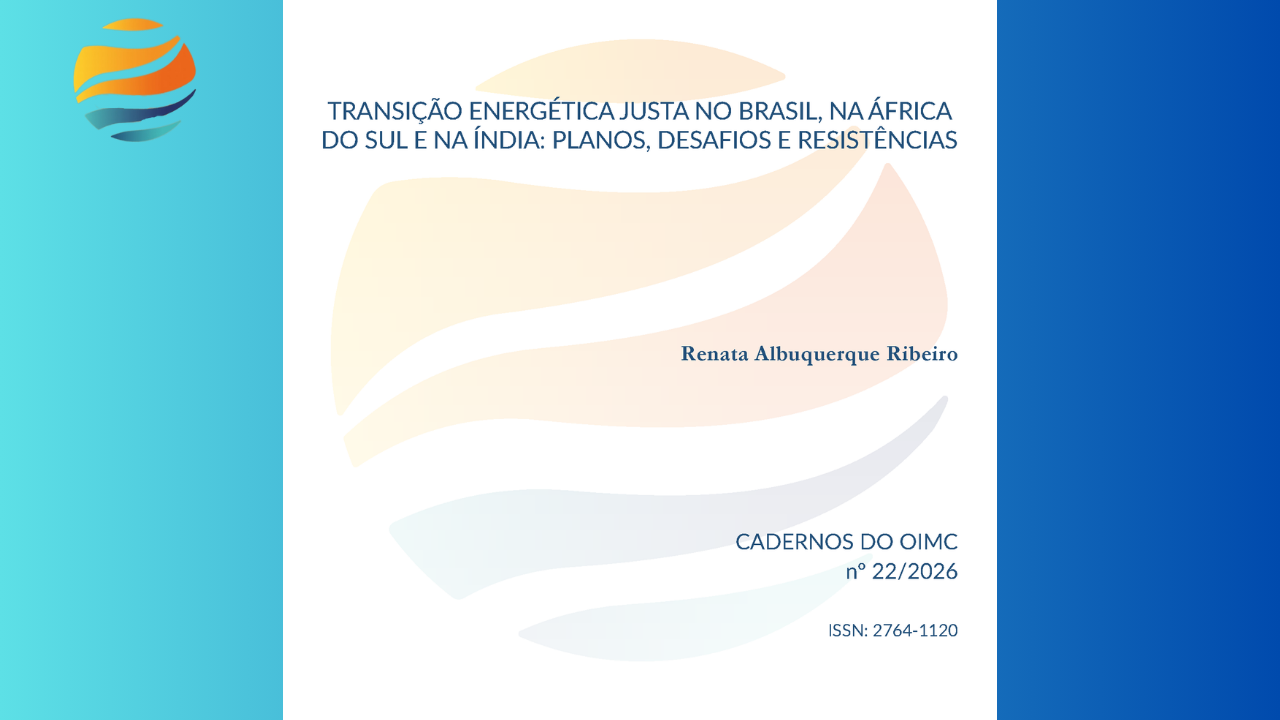
The Interdisciplinary Observatory on Climate Change is releasing the first edition of 2026 of Cadernos do OIMC. In its 22nd volume, our series of publications featuring academic papers on various aspects of the climate emergency presents the article Transição energética justa no Brasil, na África do Sul e na Índia: planos, desafios e resistências (Fair Energy Transition in Brazil, South Africa, and India: Plans, Challenges, and Resistance), by political scientist Renata Albuquerque Ribeiro (LABMUNDO).
Read the text summary:
This OIMC Notebook aims to present and analyse the institutional processes of energy transition underway in the countries of the Geopolitical South. To this end, three case studies were selected: Brazil, India and South Africa. The analysis is based on three key elements: the greenhouse gas (GHG) emissions profile, especially in the energy sector; the performance of the three countries at the United Nations Climate Conferences (COPs); and the respective proposals, challenges and resistance present in the domestic context, which hinder the broader processes of fair energy transition in these cases. Finally, some concluding remarks are presented.
PhD and Master’s degree in Political Science from the Institute for Social and Political Studies (IESP-UERJ), Renata Albuquerque Ribeiro is a research associate at the World Political Analysis Laboratory (LABMUNDO) and a senior researcher at Zero Carbon Analytics. She has taught as a substitute professor at the Institute of International Relations and Defence (IRID-UFRJ), professor at the Council on International Educational Exchange (CIEE), and visiting professor in the Bachelor’s Degree program in International Relations at the Federal University of ABC (BRI-UFABC). She was a visiting researcher at the University of South Africa (Unisa) and the Institute for Global Dialogue (IGD), both in South Africa, and a researcher at the Directorate of International Relations of the Institute of Applied Economic Research (Dinte-Ipea), as well as having worked in various civil society organisations in Brazil and abroad.